
AI Tools Available to the FAS
Experiment with multiple LLMs in secure environment. Click here to see our short video on the AI sandbox Features: Code generation, Creative writing, Data analysis, Summarizing, Text generation and editing, Image generation, Translation | Managed by HUIT. Available to FAS faculty, staff, students, and researchers. Access the getting started guide and latest list of included models in the HUIT knowledge base. | |
Versatile chatbot able to generate text, code, and more. Click here to see our short video on Gemini Features: Code generation, Creative writing, Data analysis, Image and storybook generation, Summarizing, Text generation and editing, Translation | Gemini Basic is available to FAS faculty, staff, students, and researchers as part of Harvard's Google Workspace license. Gemini Pro is available upon request using the FAS GenAI Tool License Request form. | |
Versatile chatbot able to generate text, code, images, and more. Features: Chatbot customization, Code generation, Creative writing, Data analysis, Image generation, Summarizing, Text generation and editing, Translation | Available to FAS faculty, staff, students, and researchers is available upon request using the FAS GenAI Tool License Request form. | |
Anthropic Claude | Versatile chatbot able to generate text, code, and more. Features: Code generation, Creative writing, Data analysis, Image and storybook generation, Summarizing, Text generation and editing, Translation | Claude is available to FAS faculty, staff, students, and researchers upon request using the FAS GenAI Tool License Request form. |
Versatile chatbot able to generate text, code, and more. Features: Custom GPTs, Chat, Writing and editing, Data analysis, Web-based deep research, Image generation, Music generation | Copilot basic is available to FAS faculty, staff, students, and researchers. Access to the Pro version, which includes integration with Microsoft 365 apps and access to OpenAI models, is available upon request using the FAS GenAI Tool License Request form. | |
A platform for using large language models for teaching and learning. Features: Create and share custom bots for specific tasks, like serving as a virtual teaching assistant with access to course documents. | Available to faculty and instructors for use in FAS courses. | |
Prevent students from using AI during online, in-person exams. Features: Disabled computer functions, access to specific web domains, integrated with Canvas. | Available to faculty and instructors for use in FAS courses. | |
Generate images and text effects by simply typing key words or a description. Trained on stock images, openly licensed and public domain content. Also integrated into Adobe apps. Features: Image generation, Image editing | Available to FAS faculty, staff, students, and researchers as part of Harvard's Adobe Creative Cloud license. | |
Coaching Bot | A configurable chatbot for course-specific support. Features: Allows instructors to write system prompts and upload course documents to direct chatbot behavior. Includes model, temperature, and reference document configuration options. | Available to faculty and instructors for FAS courses. Can be installed in Canvas. |
API Access | Use code to access OpenAI models for AI functionality in scripts, tools, and other programming projects. Features: Text generation, Summarizing, Code generation, Translation, Data analysis | Available to FAS faculty for teaching and learning use. Please contact atg@fas.harvard.edu for details. OpenAI for Community Developers API access is available to FAS constituents for teaching, learning, and experimentation. Each individual who registers for access and claims an API key will have access to $10/month in OpenAI API credits. |
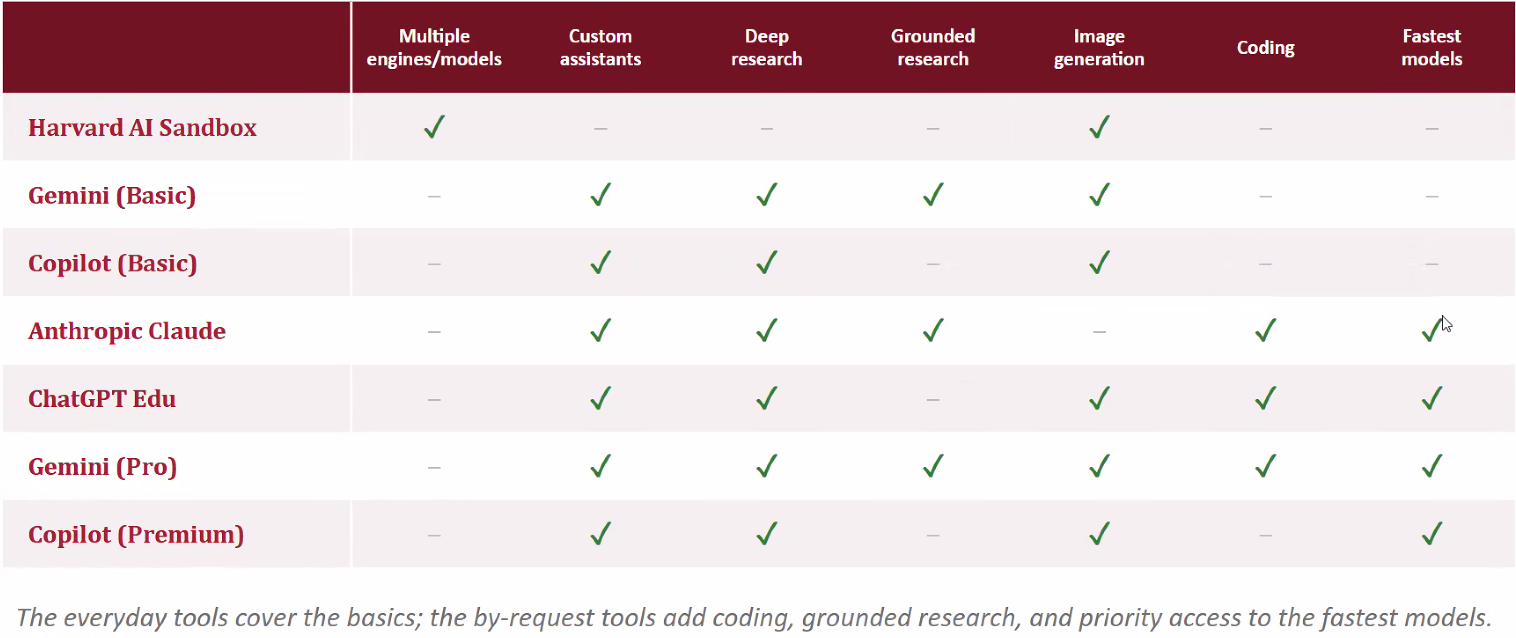
Tool Comparison Grid
Guidance on the Use of AI Services in Applications
For more information, see University guidelines on the use of generative AI, the list of approved AI tools, and HUIT's policy regarding the development of custom apps for FAS courses.
- Applications used in courses may not send Harvard confidential information, including student information, student-generated content, and course data, prompts, files, or user-generated content, to publicly available or unapproved AI tools.
- Use only AI tools and services that have been approved for Harvard work and have appropriate contractual security and privacy protections. Do not use public or consumer AI tools for Harvard confidential data, since information entered into those tools may not be private and may be used in ways that are not appropriate for Harvard work.
- Approved AI tools should provide appropriate Harvard data protections, including assurances that data entered will not be used to train vendor models.
- If an application uses an external AI API, model provider, chatbot, AI assistant, transcription service, summarization tool, coding assistant, or similar service, confirm that the service is approved for the intended Harvard data classification before use.
Where can I get help?
- If you need help with account creation or access, please contact the HUIT Service Desk.
More resources: